
udawalawe safari from galle
Udawalawe Evening Safari from Galle: What It's Really Like
Quick Takeaways: Udawalawe Evening Safari from Galle
- Afternoon drives trade harsh midday glare for a long golden hour
- Elephants move toward open water as the heat drops
- You leave Galle after lunch instead of before sunrise
An honest account of the late-afternoon game drive at Udawalawe National Park, leaving from Galle and the south coast — the light, the elephants, and the long golden hour that most day trips miss.
Most people book Udawalawe for the morning. They set an alarm in the dark, drive inland while the coast is still asleep, and reach the gate with the day ahead of them. It works, and there is nothing wrong with it. But if you ask the drivers who make this run several times a week which drive they would choose for themselves, a lot of them will tell you the same thing: go in the afternoon.
Leaving the coast after lunch
The drive inland from Galle is one of those journeys where you can feel the landscape change around you. The coast road gives way to interior roads, the salt goes out of the air, and the horizon starts to lift. Rubber and rice give way to scrub and open country, and somewhere along the way the light stops being flat and starts having direction to it.
Because you are travelling in the afternoon rather than before dawn, you actually see this. On a morning run most of it happens in the dark, and the first thing you register is the park gate. Going later, the approach becomes part of the day rather than something to sleep through.
An afternoon departure also means your morning stays yours. You can have a slow breakfast, swim, wander the ramparts at Galle Fort, and still be on the road in good time. For travellers who have already spent several days getting up early for temples and train rides, that alone changes the mood of the whole trip.
Why the elephants come out when the heat goes
Udawalawe is open country — grassland and scrub around a large reservoir, with far fewer places for animals to disappear into than a dense forest park. That openness is the whole point. You are not hunting for a glimpse of something through the trees; you are watching animals move across a wide landscape.
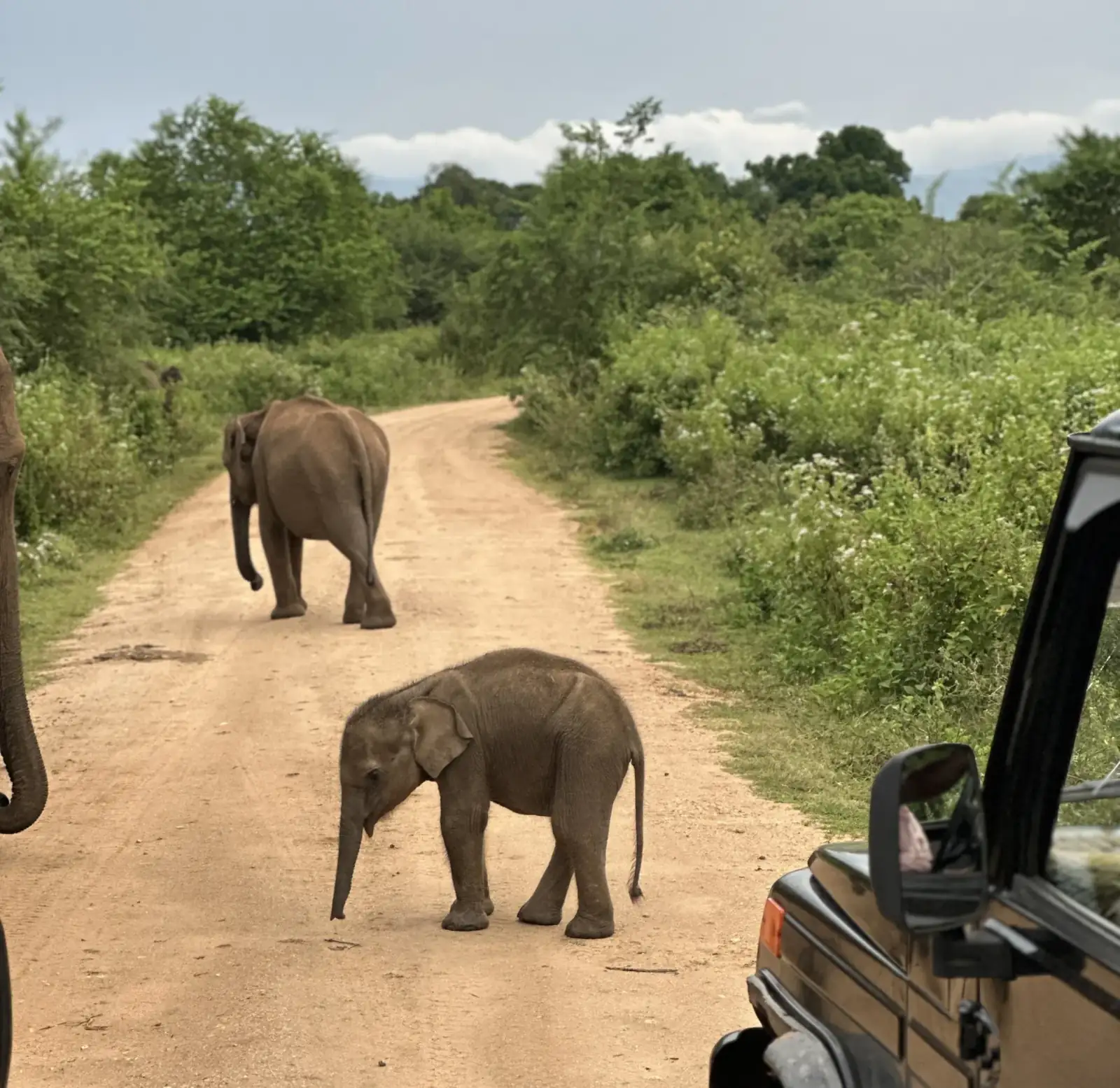
Through the middle of the day, that landscape is hot and the herds tend to keep to shade and stillness. As the afternoon cools, they start moving again — down toward the water, out into the open, unhurried. What you get on an evening drive is not a single sighting but a slow accumulation of them: a family group crossing ahead of the jeep, a lone bull working through the scrub, calves being shepherded along in the middle of a moving wall of adults.
The reservoir pulls everything toward it. Sit near the water late in the day and the park comes to you rather than the other way round. There is a particular quiet that settles over a jeep when a herd is close enough that you can hear them breathing and pulling at the grass — nobody planned it, everyone stops talking at the same time.
The light is the reason photographers choose the evening
Anyone who takes pictures seriously will tell you that midday in Sri Lanka is difficult. The sun is overhead, contrast is brutal, and grey animals against pale grass tend to come out flat.
Late afternoon solves that. The sun drops low enough to come at the landscape sideways, and everything gains shape: dust hanging in the air turns gold, grass goes translucent, and the ridges on an elephant's back suddenly read as texture rather than a grey mass. The last stretch of a good evening drive is often the part people remember, when the whole park turns amber and the shadows run long across the open ground.
You do not need expensive equipment to benefit from this. A phone in good light beats a serious camera in bad light, and the evening simply hands you better light for free.
What the drive itself is like
Safari jeeps here are open-sided and higher off the ground than you expect, which is what makes the sightlines work. The tracks are rough in places — that is part of it, and most people stop noticing after ten minutes because they are looking at something else.
A game drive at Udawalawe is not a silent, reverent experience. There is engine noise, radio chatter between drivers when something worth seeing has been spotted, and a certain amount of holding on. But when the jeep cuts the engine near a herd, the silence that replaces it is genuinely striking.
Beyond elephants, Udawalawe is a strong birding park — eagles and kingfishers over the water, peacocks in the open, storks working the shallows. Water buffalo, spotted deer, crocodiles along the banks, and if you are lucky and quiet, jackal. The park's residents are used to vehicles, so animals generally carry on with what they were doing rather than melting away.
Coming home in the dark
The return leg has a completely different feeling from the outbound one. People are usually quiet, sunburnt in a mild way, scrolling back through photographs and comparing what they caught. The countryside goes past in silhouette and then the coast smell comes back through the windows.
You get back to Galle, Mirissa, or Hikkaduwa in the evening rather than the middle of the afternoon, which suits some travellers and not others. If you want a full beach afternoon afterwards, take the morning drive instead. If you would rather come home to dinner with a day's worth of stories, the evening run is the better shape.
Either way it is a long day and the driving is a real part of it. Going with a private vehicle and a driver who knows the route means the transit is comfortable rather than something to endure — and that you are not negotiating anything at the gate after a three-hour drive.
Who the evening drive suits
This shape of day works particularly well for a few kinds of traveller.
- Photographers and anyone who cares about light, for obvious reasons.
- Couples who would rather not start a day at four in the morning.
- Travellers already several days into a packed cultural itinerary who need one gentler start.
- Families with children who handle an afternoon outing better than a pre-dawn departure.
- Anyone staying on the south coast who wants a safari without relocating inland for a night.
“Perfect day trip to Udawalawe! The transfer was comfortable and the driver was professional. Saw so many elephants!”
A few honest caveats
No park guarantees anything. Udawalawe is about as reliable as Sri Lanka gets for elephants, and it would be unusual to leave without seeing them, but wildlife does not run to schedule and anyone who promises you otherwise is selling something.
Weather matters. Rain can flatten an afternoon, and during wetter spells the park is greener but the animals are more scattered because water is everywhere rather than concentrated. In drier stretches, sightings around the reservoir become far more predictable.
Bring more water than you think you need, something for the sun, and a layer for the drive home — open jeeps get cool once the light goes. Neutral colours are sensible. And leave the schedule loose at the back end; the best part of an evening drive is usually the last half hour, and you do not want to be checking your watch through it.
Tours matching this udawalawe safari from galle guide
- Udawalawe Safari Transfers – 3 to 5 Hours1 day · South Coast
- Galle City & Coastal Day Tour – 8 Hours1 day · South Coast
udawalawe safari from galle — common questions
Is an evening safari at Udawalawe worth it?
Yes, if you want elephants and good light rather than a leopard hunt. Elephants move to open ground and water as the day cools, so the late-afternoon drive is when the park is most active, and the low sun is what photographers come for.
Are you guaranteed to see elephants at Udawalawe?
Nothing in a national park is guaranteed, but Udawalawe is the most reliable elephant park in Sri Lanka. A substantial resident herd stays in the park year-round rather than migrating, and it concentrates near the reservoir in the dry months.
How long does a safari at Udawalawe take?
Plan on three to five hours door to door from the south coast, including the drive each way and the game drive itself. The drive home is in the dark, which is worth knowing before you book an evening slot.
Action Items You Can Use Today
- Afternoon drives trade harsh midday glare for a long golden hour
- Elephants move toward open water as the heat drops
- You leave Galle after lunch instead of before sunrise
Sources: Udawalawe Evening Safari from Galle
Continue reading
Need help planning this route?
Our team can build a custom itinerary based on your dates, interests, and budget.